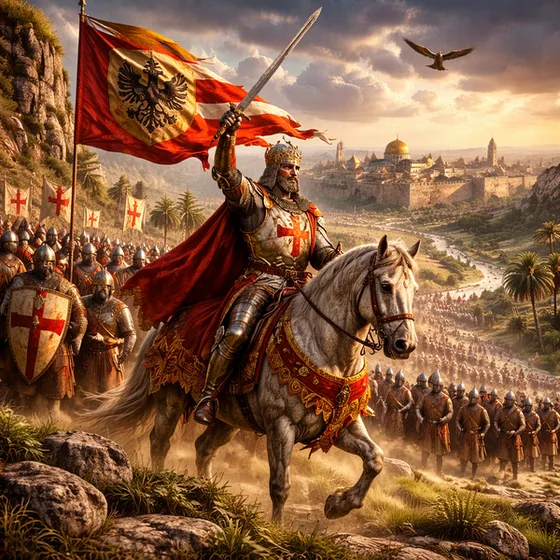
Almost a thousand years after Paul's missionary journeys, armies from the West marched through the same landscapes of Asia Minor – under the sign of the cross, but often with the sword in hand. This study tour follows their routes from the Bosphorus to the Mediterranean coast and asks an uncomfortable question along the way: what happened here in the name of Christ, and what does the gospel say to us about it?
Along the way lie sites where the Bible itself speaks: Antioch in Pisidia and Iconium, where Paul and Barnabas preached, Seleucia as the port of the first missionary journey, Tarsus as the apostle's home town, and Antioch on the Orontes, where the believers first bore the name Christians. In between stand Nicaea, the rock churches of Cappadocia, Edessa as the first Crusader state, and the Saleph, in which Frederick Barbarossa drowned in 1190.
We do not pass over the sack of Constantinople in 1204, nor the experiences of Byzantines, Armenians and Muslims. Devotions at selected places gather what has been seen into prayer and reflection on guilt, forgiveness and peace. A state-licensed, English-speaking tour guide accompanies you through all twelve days.
The Bible reading path
Passages you will read on site
Acts 13:14–52Antioch in Pisidia
Paul's great synagogue sermon – read at the basilica built over this place.
Acts 14:1–6Iconium (Konya)
Paul and Barnabas proclaim the word and have to move on in the face of hostility.
1 Pet 1:1Cappadocia
The apostle greets the strangers in Cappadocia – the rock churches of Göreme show how deeply the faith took root here.
Acts 11:19–26Antioch on the Orontes
Barnabas brings Paul to Antioch, and here the disciples are called Christians for the first time.
Gal 2:11Antioch on the Orontes
The dispute between Paul and Peter over table fellowship – an early struggle for the unity of the church.
Acts 13:4Seleucia Pieria
From Antioch's port Paul and Barnabas sail to Cyprus – the beginning of the first missionary journey.
Acts 21:39Tarsus
Paul calls himself a citizen of this “no mean city” in Cilicia.
Acts 13:13Perge
Here John Mark parts from the apostles and returns to Jerusalem.
Acts 14:25–26Attalia (Antalya)
After preaching in Perge, Paul and Barnabas go on board at Attalia – back to Antioch.
Tip: bring your own Bible – at each place we open the relevant passage together. Bible quotations: King James Version.
Day by day
Itinerary
Day1
Arrival on the Bosphorus
Istanbul Airport → hotel
At the airport your tour guide, who is at home in Turkey, awaits you and accompanies you to the hotel. At the welcome drink in the evening the big picture of the journey emerges: Emperor Alexios I's call to the West for help in 1095, the appeal of Clermont and the People's Crusade of Peter the Hermit. A word of blessing places the days together under God's guidance before dinner concludes the day of arrival.
Overnight: Istanbul
Day2
Constantinople – splendour and wound of a city
Hagia Sophia → Hippodrome → Land walls → Fener
The first Crusader armies camped before the walls of this city in 1096/97 – and in 1204 it was conquered and plundered by Crusaders themselves. In Hagia Sophia, a mosque again since 2020, your guide shows you the memorial stone of Doge Enrico Dandolo in the gallery; at the Hippodrome we recall the Quadriga that ended up in Venice. At midday follow the Theodosian land walls and the Blachernae quarter, where Alexios I made the leaders swear an oath. In the Cathedral of St George in Fener rest relics that returned from Rome in 2004 as a sign of reconciliation.
Overnight: Istanbul
Day3
Via Nicomedia and Nicaea to Dorylaeum
Istanbul → İzmit → İznik → Eskişehir
Like the armies in the spring of 1097, we cross over to Asia. In İzmit, ancient Nicomedia, Emperor Diocletian had his residence; his edicts of 303 launched the last great persecution of Christians. Not far away the People's Crusade was wiped out in 1096. At midday we reach Nicaea with the walls and gates besieged in 1097 and Hagia Sophia, venue of the council of 787 – an occasion also to remember the creed of 325. Near Eskişehir lies the battlefield of Dorylaeum, where the Crusaders were victorious in 1097 and Conrad III was defeated in 1147.
Overnight: Eskişehir
Day4
With Paul to Antioch in Pisidia and Iconium
Eskişehir → Afyon → Yalvaç → Akşehir → Konya
Today the path of the Crusaders crosses that of the apostle. Near Yalvaç lies the Roman colony of Antioch in Pisidia with the Temple of Augustus and the Basilica of St Paul above the site of the synagogue in which Paul preached. The chronicler Albert of Aachen reports that Godfrey of Bouillon was badly injured by a bear here in 1097. At the foot of the Sultan Mountains we drive via Akşehir, ancient Philomelion, where Barbarossa was victorious in 1190, to Konya – Iconium, where Paul and Barnabas proclaimed the gospel despite opposition.
Acts 13:14–52Acts 14:1–6Overnight: Konya
Day5
From Konya into the rock world of Cappadocia
Konya → Sultanhanı → Göreme
In the morning we visit the Alaeddin Mosque on Konya's citadel hill – at its foot Barbarossa took the city in May 1190 and afterwards made peace with Sultan Kılıç Arslan II – as well as the Mevlana Museum with the tomb of Rumi. Across the plateau that the thirsty army crossed in 1097, we follow the Silk Road to the Sultanhanı caravanserai of 1229. In the afternoon the Göreme Open-Air Museum opens its rock churches with Byzantine frescoes, including the Tokalı Church – traces of the Christians of Cappadocia, whom the First Epistle of Peter already greets.
1 Pet 1:1Overnight: Cappadocia
Day6
Kaymaklı, Caesarea and the Anti-Taurus
Göreme → Kaymaklı → Kayseri → Göksun → Kahramanmaraş
In the underground city of Kaymaklı we descend several storeys deep into the tuff, where the population sought shelter in troubled times. At midday we reach Kayseri, ancient Caesarea, where Basil the Great was bishop; the citadel and Seljuk buildings lie here at the foot of Mount Erciyes. Then begins the stretch that the chroniclers in October 1097 called the “Devil's Mountain”: via Göksun, the Coxon of the Crusaders, and over the passes of the Anti-Taurus down to Marash, where Armenian princes received the exhausted army.
Overnight: Kahramanmaraş
Day7
Zeugma and Edessa – the first Crusader state
Kahramanmaraş → Gaziantep → Şanlıurfa
In the Zeugma Mosaic Museum in Gaziantep you encounter the Roman mosaic floors of the city at the crossing of the Euphrates, above all the famous “Gypsy Girl”. In the afternoon we reach Şanlıurfa, ancient Edessa: in 1098 Baldwin of Boulogne became count here, and when the county fell to Zengi at Christmas 1144, it provoked the Second Crusade. From the citadel with its two columns we look down on the fish ponds where tradition places Abraham; the story of King Abgar and the image of Christ, the Mandylion, is also at home here. In the evening we walk through the bazaar.
Overnight: Şanlıurfa
Day8
Antioch – mother church of the mission to the Gentiles
Şanlıurfa → Gaziantep → Antakya
The drive leads across the Euphrates through the land over which Baldwin, Bohemond and Tancred once fought, to the Orontes. For eight months the Crusaders lay before Antioch, until they broke into the city on 3 June 1098. Long before, however, it had been the starting point of the mission to the Gentiles: in the Grotto of St Peter on Mount Staurin, by tradition the meeting place of the first church, we read how the disciples were first called Christians here. To finish, a look at the earthquake-stricken old town being rebuilt and – depending on opening – the Archaeological Museum.
Early in the morning we stand in Seleucia Pieria, the port of Antioch from which Paul and Barnabas set out on the first missionary journey; Roman engineers cut the Titus Tunnel into the rock here. Above the Belen Pass the Templar castle of Bagras keeps watch, with the plain of Issus below. After a photo stop at the Armenian “Snake Castle” Yılankale we reach Tarsus with St Paul's Well, the St Paul Memorial Church and Cleopatra's Gate – here, in 1198, Leon I was also crowned King of Lesser Armenia. In the evening, arrival by the sea in Kızkalesi.
In front of the hotel rise the land and sea castles of Corycus, fortresses of the Armenians and later of the Lusignans. Then we visit the cave church of Thekla, by tradition a disciple of Paul, and the remains of her great basilica, which the pilgrim Egeria visited as early as 384. On the bank of the Göksu, the ancient Saleph, a memorial stone recalls Frederick Barbarossa, who drowned here on 10 June 1190 – space for a devotion on transience and hope. Along the cliffs of Rough Cilicia we travel to Mamure Castle and on to Alanya.
Overnight: Alanya
Day11
Aspendos, Perge and Attalia
Alanya → Aspendos → Perge → Antalya
In Aspendos stands the best-preserved theatre of antiquity, with the remains of the aqueduct nearby. In Perge, the colonnaded street, agora and city gate lead back to the time when Paul and Barnabas preached the word here. In the afternoon in Antalya: Hadrian's Gate, Kaleiçi and the harbour of ancient Attalia. Here the apostle went on board for Antioch – and here King Louis VII sailed away with his nobles in 1148, while many pilgrims were left behind. At the farewell evening we ask together what this journey teaches about faith, power and reconciliation.
Acts 13:13Acts 14:25–26Overnight: Antalya area
Day12
Farewell to Anatolia
Antalya → Antalya Airport
Depending on your departure time, the transfer takes you to Antalya airport. If you would like to stay longer, you can extend the tour with beach days on the Turkish Riviera or the Aegean. What stays with you is a route from Constantinople to Attalia that has laid bare the light and shadow of church history – and the prayer for peace between peoples and religions, which Jesus promised to the peacemakers.
⛔ No shopping stops: carpet, jewellery or leather showrooms are not part of this tour.
Included
11 nights in 4- and 5-star hotels with half board (breakfast and dinner buffet)
Round trip in an air-conditioned coach, airport transfers in Istanbul and Antalya
State-licensed, English-speaking tour guide (guided tours available on request in a total of 25 languages)
Entrance fees as per programme
Welcome drink on the first evening
Not included
Flights – on request we will enquire about suitable connections for you
Lunches and drinks
Tips (guideline: tour guide approx. €3–5, driver approx. €2–3 per day)
Travel insurance
Good to know
Frequently asked questions
Are the Crusades glossed over on this tour?
No. We speak openly about the events – including the sack of Constantinople in 1204 – and let Byzantine, Armenian, Muslim and Latin voices be heard. Biblical reflections on guilt, forgiveness and peace accompany the visits.
How fit do you need to be?
On some days 400 to 480 kilometres by coach lie ahead of you, with regular breaks. The walks are mostly short; at the castles and in the underground city it can get steep or narrow.
Can Antakya and Kahramanmaraş be visited after the earthquake?
Yes. Both cities are being rebuilt. Hotels and visits are adapted to the current situation; individual sites may at times be only partly accessible.
Can the tour be booked by church groups and individual travellers?
Yes. Churches, home groups and Christian associations travel as a group from 9 people; as a private tour it is possible from just one person. As a contact office we put you in direct contact with our partners in Turkey.
How much does the tour cost?
The price is available on request, as it depends on dates, group size and room allocation. You will receive a personal offer – free of charge and without obligation.
Is the flight included?
No, the flight is not included; you arrive in Istanbul and depart from Antalya. On request we will enquire about suitable connections for you.
Enquiry & booking
Enquire about this tour
On the Routes of the Crusaders – from Constantinople to Attalia